GriffinGames.
Browser party games for game night. One person puts it on the TV, and everyone joins from their phone with a room code. Nothing to install, no accounts.
- Role
- Solo: design, frontend, backend, deployment
- Timeline
- 2025 – present
- Stack
- JavaScript, Node.js, Express, Socket.IO, Groq
How it works
The TV is the host screen. Every phone is a controller. A Node server holds each room’s state and pushes it to every screen over Socket.IO whenever anything changes.
What was tricky
Deciding who buzzed first
Phones can’t be trusted to agree on timing, so the server is the only source of truth. The first buzz event to reach it locks the question, and every screen gets the result from the same room state.
Phones that drop off mid-game
Screens lock and Wi‑Fi drops at every game night. Players can rejoin a game in progress with their score intact. If the host drops, control passes to another player in a consistent order and comes back when the host returns. Duplicate names are rejected instead of kicking the original player.
Grading free-response answers
In “Off the Dome” rounds, players type their answers. An LLM (Llama 3.1 on Groq) grades them, so typos, alternate spellings, and last names still count. A few hard rules run first, like rejecting acronyms with swapped letters, and grading times out after six seconds so a slow response never stalls the round.
Adding new games
Each game is a module that exports an id, a name, and a create() function. Room handling, sockets, and reconnects don’t change when a new game is added.
The games
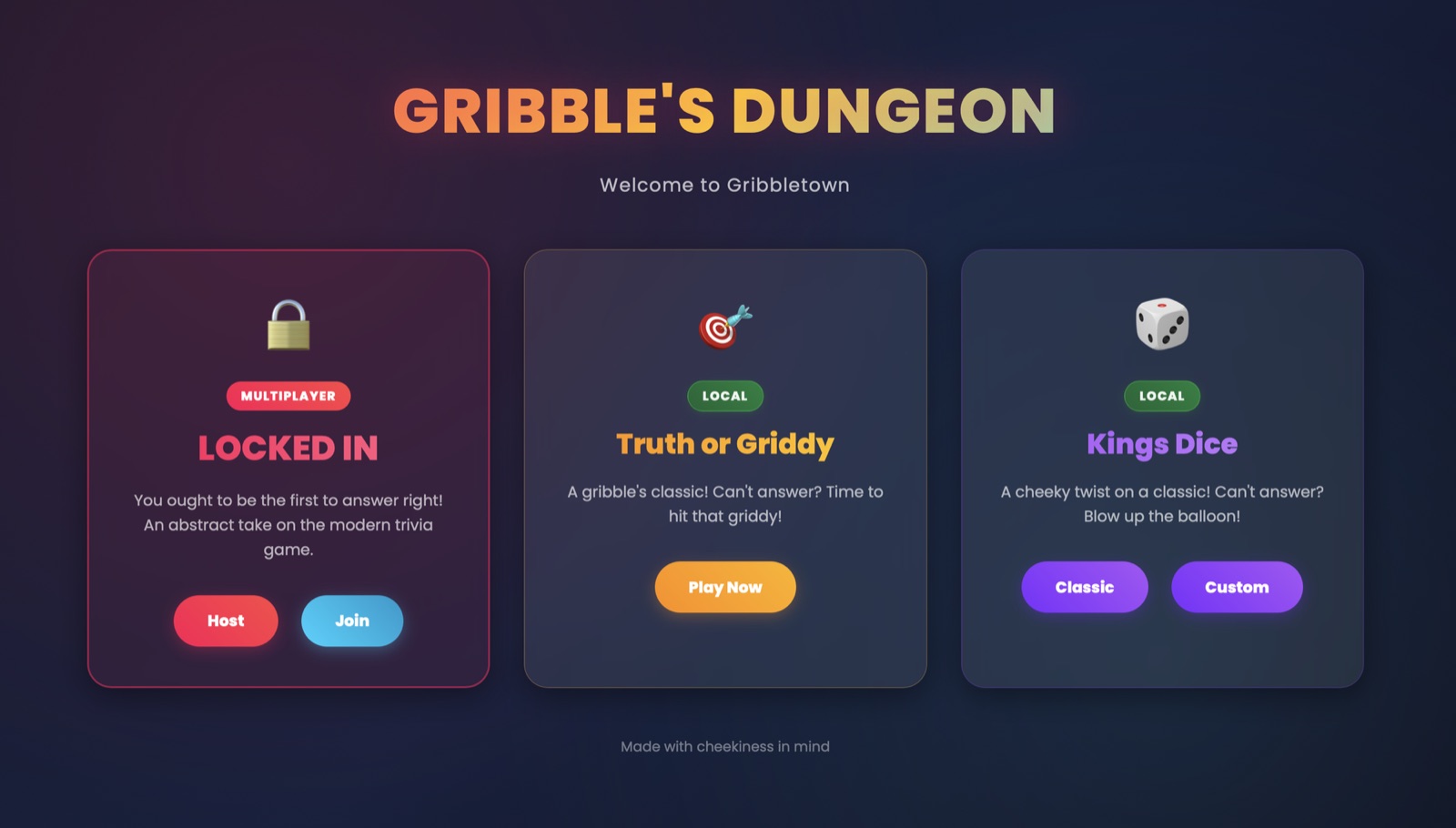
Three games, all played from the same room code. Tap any screenshot to see it full size.
LOCKED IN
Buzzer trivia. The host screen shows the question, the timer, and live standings. Players buzz in from their phones.
Truth or Griddy
Four themed decks of about 600 prompts each. Answer the question, or hit the griddy.
Kings Dice
Roll, and the total picks a rule. Rather not? Pump the balloon and hope it doesn’t pop.
Testing and deploying
The frontend is plain JavaScript on Netlify. The server runs on Render. Both deploy from main, and all work happens on a testing branch first.
GitHub Actions runs the server’s tests on every push, covering joining, host transfer, and reconnects. End-to-end browser tests start the site and server together and play through LOCKED IN.